
Our Indian Trail Honey Just Tested in Mānuka Territory


We sent a jar of our raw honey to Dr. Ferhat Ozturk's lab at MediBal in San Antonio for independent bioactivity analysis. The results came back on July 16, and I have been grinning about them ever since.
Sample 25AC-6. Harvested right here in Indian Trail, North Carolina. Here is what the lab found:
Measure | Our honey | What it means |
|---|---|---|
Zone of Inhibition | 16.23 mm | Above the 16 mm high-activity threshold |
pH | 4.20 | Squarely in honey's optimal acidity range (3.2–4.5) |
Moisture | 15.3% | Well under the 18.6% USDA Grade A ceiling |
What a Zone of Inhibition actually measures
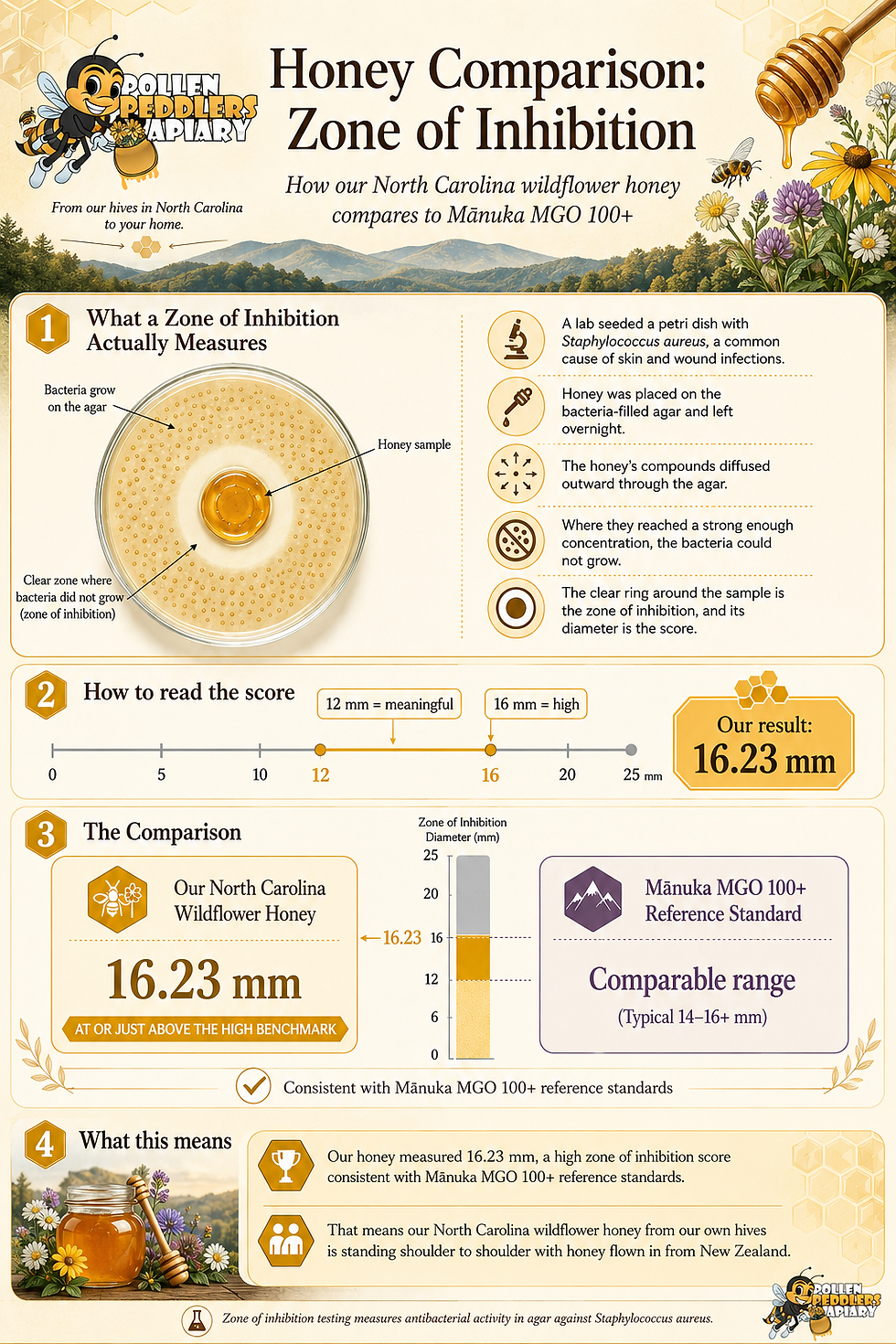
The lab seeded a petri dish with Staphylococcus aureus, the organism behind a huge share of skin and wound infections, and one that has gotten harder to treat as antibiotic resistance spreads. They placed our honey on that lawn of bacteria and let it sit overnight.
The honey's compounds diffused outward through the agar. Wherever they reached in sufficient concentration, the bacteria simply could not grow. The next morning there was a clear ring around the sample, and the diameter of that ring is the score. Twelve millimeters is considered meaningful. Sixteen is considered high.
Ours came in at 16.23 mm, consistent with Mānuka MGO 100+ reference standards, the grade most people think of when they think of medicinal honey.
That is North Carolina wildflower honey from our own hives, standing shoulder to shoulder with honey flown in from New Zealand.
Why this is scientifically interesting (and not the same thing as Mānuka)
Here is the part I find genuinely fascinating, and I want to be precise about it rather than just wave a flag.
Mānuka's antibacterial punch is non-peroxide. It comes from methylglyoxal, which forms from dihydroxyacetone present in the nectar of the Leptospermum shrub. That compound is stable. It sits there in the jar for years, largely indifferent to heat and light.
Most other honeys, ours included, work primarily through a different mechanism. Bees add an enzyme called glucose oxidase to nectar as they process it. When honey is diluted, that enzyme produces hydrogen peroxide slowly and continuously, at concentrations far below what you would ever pour out of a brown bottle. Add the low water activity, the acidity, and a supporting cast of plant-derived polyphenols, and you get real, measurable antibacterial performance.
Same result on the plate. Different chemistry getting there.
That distinction has a practical consequence, so file it away: glucose oxidase is heat-sensitive and light-sensitive. Warm our honey aggressively or park it on a sunny windowsill and you are degrading the very thing that produced that 16.23 mm ring. Keep it cool, keep it dark, and never microwave it.
The two numbers nobody celebrates, but should
Moisture at 15.3% is the quiet win here. Under 18.6% is the Grade A standard; under 17% is where fermentation risk falls away. At 15.3%, this honey was capped by bees who finished the job properly, and it will sit stable on a shelf essentially indefinitely. That number is not luck. That is colony strength, good forage, and not pulling frames early.
pH at 4.20 puts it in the sweet spot of honey's natural acidity, an environment most bacteria find genuinely inhospitable, entirely independent of the peroxide activity.
The three numbers reinforce each other. High bioactivity, low water, right acidity.
So what do you do with it besides put it on toast?
Plenty. A few directions worth exploring:
In your skincare routine. Honey is a humectant, it pulls moisture from the air and holds it against your skin. A thin layer left on for ten or fifteen minutes as a mask, then rinsed with warm water, is one of the oldest and simplest beauty treatments there is. It also works as a gentle cleanser for reactive skin that reacts badly to foaming surfactants.
On your hair. A spoonful whisked into a conditioner or into warmed oil makes a deeply moisturizing pre-shampoo treatment. Rinse thoroughly unless you enjoy attracting curious bees.
Lips, cuticles, dry heels. Straight from the jar, or blended with a little beeswax and oil into a balm.
As an infusion base. The low moisture means this honey is a stable carrier. Garlic, ginger, elderberry, rosemary, hot peppers, lemon peel; all of it infuses beautifully and keeps well.
In the kitchen as a preservative, not just a sweetener. Honey-cured salmon, honey-brined poultry, fruit preserved in honey. The same water activity that keeps the honey shelf-stable works on what you put in it.
Fermented and cultured products. Mead, of course, but also honey-sweetened water kefir and kombucha second ferments.
Soap and salve. Honey in cold-process soap adds humectancy and a gorgeous color. Blended with propolis and beeswax, it becomes a salve for weather-beaten hands.
One honest note. This certificate documents laboratory antibacterial activity against a bacterial culture in a dish. It is not a medical product, it is not sterile, and it is not the same thing as the gamma-irradiated, medical-grade honey dressings that hospitals use for wound care; those are regulated devices, produced under conditions our kitchen cannot replicate. Enjoy this honey, put it on your face, infuse it with garlic. For anything medical, talk to your clinician.
Why we tested in the first place
Nobody required this of us. We did it because I would rather know than assume, and because "raw local honey" has become a phrase that means almost nothing at the grocery store shelf.
Now, when someone asks what makes our honey different, I do not have to reach for adjectives. I have a number, a signature, and a lab in San Antonio that has never met our bees.
Sixteen point two three.
Ready to experience the science for yourself? Grab a jar of our raw honey below.
Sample 25AC-6, tested by MediBal Honey Bioactivity Analysis, San Antonio, TX. Analysis certified by Ferhat Ozturk, PhD. Results are valid only for the sample submitted.
Beekeepers curious about their own honey can find testing information at medibal.us.


Comments